By DKZ.2R: Introduction to Machine Learning with Python and Scikit-Learn

Date: Apr 1-2, 2026
Category: Workshop
Location: Aachen (RWTH Aachen University)
Workshop Python Machine Learning Carpentries

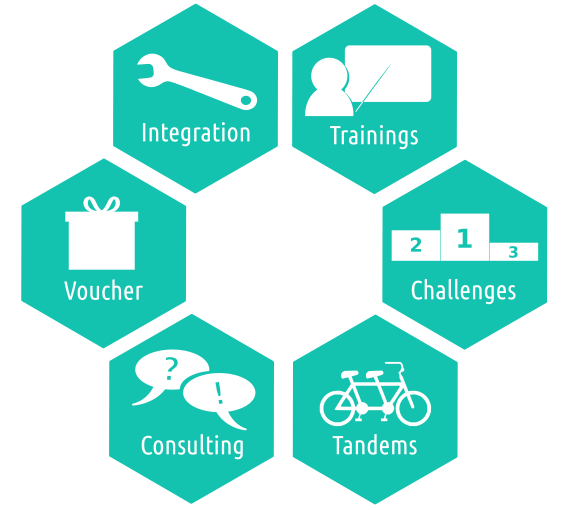
As part of our “Trainings” work package, the DKZ.2R creates, curates and presents a variety of free trainings, seminars and courses. Our next offering will be a one and a half day carpentries-style workshop on basic machine learning using python and scikit-learn, to be presented at RWTH Aachen University on 1st and 2nd of April, 2026. The workshop will cover the following topics:

  • What is Machine Learning / Why bother?
  • Supervised Methods (Regression / Classification)
  • Ensemble Methods
  • Unsupervised Methods (Clustering / Dimensionality Reduction)
  • Neural Networks
  • Ethics and Implications of Machine Learning

Workshop material is available online and will be presented by instructors who will walk you through the steps and are available for questions throughout the event. The official registration is already closed, for last-minute registrations please contact us via info@dkz2r.de.

All workshop material will also be made available online on GitHub.

A basic familiarity with Python is expected, including writing for loops, conditional statements, using functions, and importing libraries.

  • Title: Introduction to Machine Learning with Python and Scikit-Learn
  • When: Wednesday, April 1st (9am-5pm) & Thursday, April 2nd (9am-3pm)
  • Where: RWTH Aachen University, Germany (Kopernikusstraße 6, 52074 Aachen, Seminarraum 003)
  • Format: This workshop in In-Person and no remote or online attendance options are currently planned.
Related Posts

FDM-Werkstatt - Into the RDM-Toolbox!

FDM-Werkstatt - Into the RDM-Toolbox!

The Center of Data Litercacy (German: “Zentrum für Datenkompetenz”) DKZ.2R was officially launched mid November 2023. Already a month later we joined forces with fdm.nrw to organise the very first DKZ.2R-event (find the call for participation here). The “FDM-Werkstatt – Into the RDM-Toolbox” took place from March 18 to 20, 2024 at the IT Center of RWTH Aachen University. In total, 50 participants from all over Germany took part in the workshops. Many of them brought their own topics of interest with them and presented it in one of the 12 sessions. The contents of the sessions ranged from low-level introductions and RDM-basics to elaborate and in-detail coding sessions. For three days we worked together, discussed use cases and new RDM tools. But we also enjoyed the social program such as a tour of the AiX Cave and the server room of the ITC’s High Performance Computing Center. There was a good balance between cognitively demanding workshop sessions and more relaxing social events and lunch breaks which hopefully resulted in an enjoyable and rewarding experience for all participants. On the very last day of the workshop we offered a session to especially discuss ideas and directions for the DKZ.2R. The feedback we got in this session will help us in moving forward with the DKZ.2R and making a lasting impact for future researchers.

Read More
How To: Good Scientific Practice

How To: Good Scientific Practice

“Scientific integrity forms the basis for trustworthy research”, so it says in the Guidelines for Safeguarding Good Research Practice of the DFG, the German Research Foundation. As a major funder of research in Germany the DFG, as well as many other funders of research in Germany and the European Union, requires researchers to follow a certain set of rules conducting their research. These rules are called “good scientific practice” and have to be followed by researchers to be viable for funding. According to the guidelines researchers are required to “document all information relevant to the production of a research result as clearly as is required by and is appropriate for the relevant subject area to allow the result to be reviewed and assessed”. But good scientific practice is not done by documenting your research. It also includes i.a. protecting the personality rights of your subjects and handling research data in an appropriate manner by e.g. “back(-ing) up research data and results made publicly available, as well as the central materials on which they are based and the research software used, by adequate means according to the standards of the relevant subject area, and retain them for an appropriate period of time.” This is where Research Data Management (RDM) comes in. Of course RDM is much more than just creating a backup of your data on a USB-Stick and handing it over to anyone asking for it. “Good scientific practice” in RDM follows the FAIR principles:

Read More
Documentation From User Experience

Documentation From User Experience

This post is a condensed version of a talk at our Data Compentcy College

If you regularly use scientific software written by others, or tried to replicate interesting research that relies on software, you have probably also invested weeks of work to solve a software problem or even given up on a software because of missing documentation. Finding a project that might be the solution to your problem and then failing to run the code is frustrating. Being unable to run a project you have built yourself years ago is even worse. Having experienced all those setbacks myself in the past I want to use this post to channel that frustration to fuel solutions for better documentation for our current and future projects.

Read More