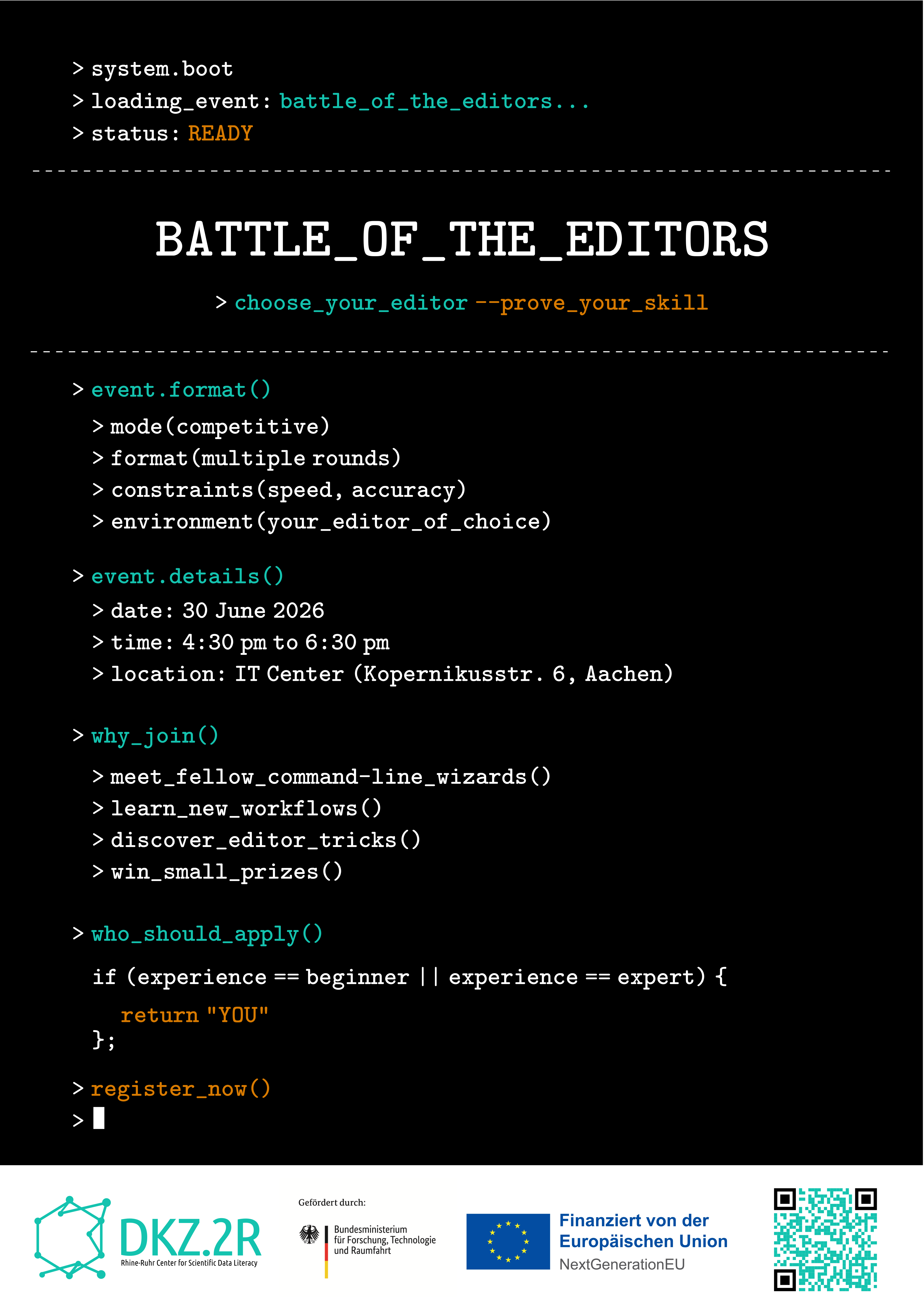
This is a fast-paced, playful competition in which participants use their editor of choice to complete a series of data and text challenges as quickly and accurately as possible. Whether you swear by Vim, live inside Emacs, prefer a modern IDE, or rely on OpenRefine for data wrangling — bring your setup and prove your skills.

Battle of the Editors

Detail Information
Date Tuesday, June 30, 2026 | 4:30 PM – 6:30 PM (Immediately following the opening of the hackathon)
Location Aachen, Seffenterweg 23 / Kopernikusstr. 6 (IT Center)
Attendance Free to attend | Open to all hackathon participants and guests
Registration To help us plan the event please sign up using this form

Why join?

  • A fun and low-stakes way to meet fellow participants before the hackathon
  • Learn new tricks from other editors and workflows
  • Small prizes for the top teams
  • Great opportunity for beginners to get a first taste of Wikidata editing in a supportive setting

May the best editor win

Before the hackathon "Archaeoanalysis of Metadata Processing" kicks off in earnest, we are warming up with a head-to-head showdown: Battle of the Editors.

Format

The Battle runs in three rounds, in which the teams have to manage various tasks using their editor of preference.

Who should come?

Everyone! You do not need to participate in the main hackathon to join the Battle of the Editors. Whether you are a seasoned command-line wizard or just curious about how others wrangle data, you are very welcome.

The Battle of the Editors is a satellite event of the Archaeoanalysis of Metadata Processing Hackathon.
To help us plan the event please: Register for the event
Event Poster

Related Posts

A Survival Guide to Research Data Sharing Services in the Rhine-Ruhr Region

A Survival Guide to Research Data Sharing Services in the Rhine-Ruhr Region

A Survival Guide to Research Data Sharing Services in the Rhine-Ruhr Region

There are a lot of reasons why collaborating with other researchers on scientific projects is great! It provides new perspectives and gives you the chance to benefit from other people’s knowledge and input. When it comes to sharing and exchanging data across multiple locations and devices however, researchers are often disoriented and don’t know which tools, cloud services and so on are safe to share data in a secure and ethical way.

Read More
Documentation From User Experience

Documentation From User Experience

This post is a condensed version of a talk at our Data Compentcy College

If you regularly use scientific software written by others, or tried to replicate interesting research that relies on software, you have probably also invested weeks of work to solve a software problem or even given up on a software because of missing documentation. Finding a project that might be the solution to your problem and then failing to run the code is frustrating. Being unable to run a project you have built yourself years ago is even worse. Having experienced all those setbacks myself in the past I want to use this post to channel that frustration to fuel solutions for better documentation for our current and future projects.

Read More
How To: Open Science

How To: Open Science

Tired of Recreating someone else’s work? - How Open Science can accelerate research and overcome reinvention

Have you ever found papers on algorithms but their implementation is missing? Found an interesting analysis but there is no way to check the results, as you don’t have access to the data they were derived from? Ever thought you had a great idea for a project, just to find out a year later that you are not the only research group following that specific idea? Not having access to other people’s code, data, metrics or even their plans for research projects often leads to unnecessary delays and scientific redundancies. There is an easy solution to overcome (almost) all of these issues. It’s called Open Science! What is Open Science? The UNESCO defines Open Science as a construct of “movements and practices aiming to make multilingual scientific knowledge openly available, accessible and reusable for everyone, to increase scientific collaborations and sharing of information for the benefits of science and society, and to open the processes of scientific knowledge creation, evaluation and communication to societal actors […]”. To ensure that everyone has access to scientific knowledge and infrastructure, Open Science focuses on four main concepts.

Read More