Announcement - Call for participation

Announcement - Call for participation

Alicia Janz

Alicia Janz

I have a background in linguistics with a specialization in phonetics. Prior to joining the DKZ.2R I studied verbal and multimodal feedback in conversation with a focus on intonation and conversational context. In December of 2023 I started working for Forschungszentrum Jülich where I am currently the main project coordinator for the DKZ.2R. To contact me or my colleague Katharina Immel you can send an e-mail to: info[at]dkz2r.de.

Update (June 24, 2024)

The call for participation is now open! Read more

Upcoming!

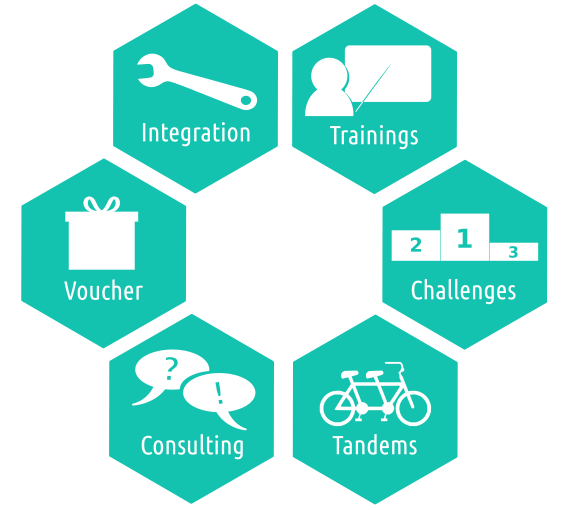
The Data Literacy Center Rhine-Rhur is issuing a call for participation in its “rent-an-expert” project! This is a great opportunity for PhD students and early postdocs who are working on research projects that involve data science, artificial intelligence, high performance computing and simulation, to get free support from our expert consultants.

Support can take the form of short- or long-term consulting, depending on the needs of the project. More info will be available shortly!
Related Posts

How To: Good Scientific Practice

How To: Good Scientific Practice

“Scientific integrity forms the basis for trustworthy research”, so it says in the Guidelines for Safeguarding Good Research Practice of the DFG, the German Research Foundation. As a major funder of research in Germany the DFG, as well as many other funders of research in Germany and the European Union, requires researchers to follow a certain set of rules conducting their research. These rules are called “good scientific practice” and have to be followed by researchers to be viable for funding. According to the guidelines researchers are required to “document all information relevant to the production of a research result as clearly as is required by and is appropriate for the relevant subject area to allow the result to be reviewed and assessed”. But good scientific practice is not done by documenting your research. It also includes i.a. protecting the personality rights of your subjects and handling research data in an appropriate manner by e.g. “back(-ing) up research data and results made publicly available, as well as the central materials on which they are based and the research software used, by adequate means according to the standards of the relevant subject area, and retain them for an appropriate period of time.” This is where Research Data Management (RDM) comes in. Of course RDM is much more than just creating a backup of your data on a USB-Stick and handing it over to anyone asking for it. “Good scientific practice” in RDM follows the FAIR principles:

Read More
Documentation From User Experience

Documentation From User Experience

This post is a condensed version of a talk at our Data Compentcy College

If you regularly use scientific software written by others, or tried to replicate interesting research that relies on software, you have probably also invested weeks of work to solve a software problem or even given up on a software because of missing documentation. Finding a project that might be the solution to your problem and then failing to run the code is frustrating. Being unable to run a project you have built yourself years ago is even worse. Having experienced all those setbacks myself in the past I want to use this post to channel that frustration to fuel solutions for better documentation for our current and future projects.

Read More
How To: Open Science

How To: Open Science

Tired of Recreating someone else’s work? - How Open Science can accelerate research and overcome reinvention

Have you ever found papers on algorithms but their implementation is missing? Found an interesting analysis but there is no way to check the results, as you don’t have access to the data they were derived from? Ever thought you had a great idea for a project, just to find out a year later that you are not the only research group following that specific idea? Not having access to other people’s code, data, metrics or even their plans for research projects often leads to unnecessary delays and scientific redundancies. There is an easy solution to overcome (almost) all of these issues. It’s called Open Science! What is Open Science? The UNESCO defines Open Science as a construct of “movements and practices aiming to make multilingual scientific knowledge openly available, accessible and reusable for everyone, to increase scientific collaborations and sharing of information for the benefits of science and society, and to open the processes of scientific knowledge creation, evaluation and communication to societal actors […]”. To ensure that everyone has access to scientific knowledge and infrastructure, Open Science focuses on four main concepts.

Read More